
Recent Contributions from Iljas
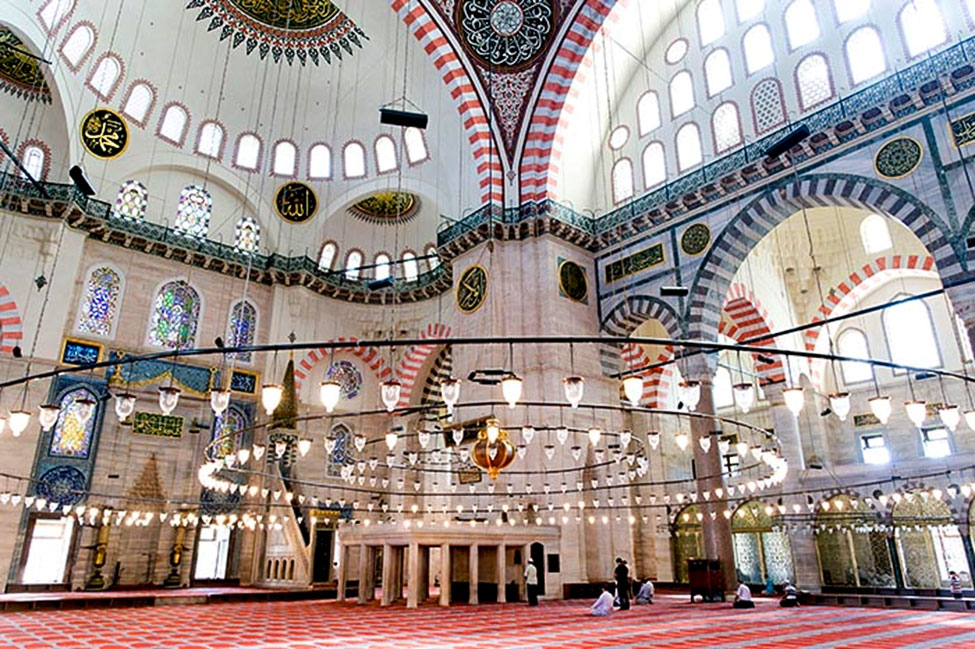
Sulemaniye Mosque
SULEMAN I
more commonly known as Suleman the Magnificent or Suleman the Lawgiver, commissioned the Sulemaniye mosque intending that it should surpass the majesty of the Hagia Sophia, a Christian Basilica built by the Byzantines ten centuries earlier. He had political intentions too. Its location on a hill made it visible from the Golden Horn and was a sign of Ottoman imperial power to the outside world. The view remains, but the empire began to decline early in the seventeenth century and ended in 1922. Such mundane thoughts now receding, I entered the mosque’s white marble courtyard with its enclosed decorated central fountain which originally provided drinking water and water for ablutions, but has not been used for centuries. Being the beginning of February, it was cold enough for snow to fall in Istanbul and I felt the cold acutely. Nevertheless, I made my way to the open-air ablution area between the side entrances to the main prayer space, facing the mihrab. The large stones directly beneath the cold-water ablution taps are noticeably worn away in parts as a result of centuries of ablution water falling on them. I happily watched my own ablution water fall there then made my way into the mosque for the prayer, like the millions of believers before me.
for centuries we’ve
come here to purify ourselves
before surrendering to the Real
The inside of the mosque is a vast almost empty space. The sense of spaciousness and the feeling of lightness are reinforced by the architect Sinan’s success in incorporating into the walls the marble pillars which hold up the vast central dome and the light coming from over 200 windows, with those on the mihrab wall made of stained glass. The dome’s central cupola is painted predominantly in gold and beneath it there are 32 windows which contribute to the sense that the dome is floating and which help to illuminate the interior. The gold colour is repeated throughout the mosque’s interior and the white is repeated on the red and white arches and on the white marble of some of the interior walls. The sense of physical unity and spaciousness theoretically makes it easier to perform the ritual prayer with khushu (the presence of the heart) so that it might “ascend towards God’s Throne”. But doesn’t the heart need to be excavated before presence of the heart can become a reality, here or anywhere?
in that vast space
the heart truly present
might taste heaven
Published in Beshara magazine in August 2025 along with another poem titled The Surprising Words of Shams-i-Tabrizi
WRITING A HAIKU
Iljas Baker writes about the gestation of a haiku published in Amethyst Review: New Writing Engaging with the Sacred and about haiku in general. A longer version of this appeared in Subud Voice in 2025.

Sparrows Haiku
Haiku
sparrows squabble at
the old stone birdbath
ah! such cool water
It was a hot summer’s day and I was sitting in the garden watching doves, crested mynah birds and sparrows vying for use of the birdbath that I had placed near a large Lignum Vitae tree, a species of tree which was brought to Thailand from Java in 1908 by King Chulalongkorn. The sparrows were no match for the larger birds and waited their turn. When the larger birds had gone, the sparrows began squabbling over which of them would use the bath next. I wasn’t thinking of writing anything, but I was struck by the life force of the birds and by their vigorous competition over a scarce resource. It was then that I began writing my haiku. It was written quite quickly, partly owing to the fact that I eschewed the traditional 5, 7, 5 syllabic count of a three-line haiku consisting of seventeen syllables and just accepted what came easily, which was three lines each consisting of 5 syllables. It does nevertheless have some traditional elements despite its non-traditional form: there is a seasonal reference (kigo in Japanese), but subtly in the last line (the cool water over which they were competing suggests it is probably summer) and there is the cutting element (kireji in Japanese) which divides the poem into two parts. In the poem it is implied in the second line. On reflection, I could have made it more obvious by putting an em dash at the end of the line. Apart from emphasizing the poems two parts, the kireji can create a pause or indicate the briefest of reflections, as it does here. A haiku is a brief poem often expressing a moment out of time that has impacted our awareness. Some haiku, as this one, can have multiple layers of meaning – usually discovered spontaneously rather than with effort.
I don’t often write haiku. They can easily come across as cute or clever rather than elemental (which I prefer) and if there are too many haiku placed together it’s almost impossible to read each one with the openness and freshness they require to be fully appreciated. Amethyst Review is a digital journal and rather than producing a monthly or bi-monthly journal full of content the editor has elected to add a new poem each day so the journal’s content is cumulative and you get to focus on one poem at a time. Thus, there are no separate journal issues as such, only an accumulation of poems classified by date. Each new poem is also sent out daily to subscribers. Most poems that appear in the journal are not haiku, but if you type “haiku” into the journal’s search engine some exquisite examples of haiku (including what I would call Christian haiku) will appear on your screen.
MATSUO BASHŌ: THE PERSON, THE POETICS
furu ike ya/ kawazu tobikomu/mizu no oto
old pond–
a frog jump’s in,
water’s sound
Matsuo Bashō’s haiku presented above is one of the most well-known and well-loved haiku in the West, yet knowledge of the author or his poetics is far from widespread. This brief essay gives some essential information on the two subjects. Bashō (1644–1694) is renowned in Japan and in the West for his unique and profound contributions to the development of Japanese poetry, particularly haibun and haiku. He was known as Matsuo Kinsaku before he changed his name to Matsuo Bashō after being gifted a bashō (banana) tree by one of his students. As a young man he was employed in the service of a well-respected and kindly Samurai family where he developed a close relationship with his employer’s son, Todo, who was also a writer of haiku and an admirer of Basho’s writings. This allowed Basho ample time to develop his poetic skills. At some point, probably after the death of a close friend (who was most likely his employer’s son) in 1666, he decided to leave traditional feudal society and attempt to establish a livelihood as a master poet. He had succeeded in this by 1680 but being dissatisfied by the literary status quo he set out to establish a personal aesthetics that “reflected spiritual depth and aesthetic subtlety.” Much of the remainder of his life was spent travelling to seek out new experiences and inspiration for his poetry.
Some commentators /translators believe that he was the first to use the word haibun to refer to a distinctive form of writing that combines autobiographical poetical prose and haiku. But Sam Hamill, one of Bashō’s foremost translators, says that Bashō “transformed” haibun: no mention of him having invented it or named it.
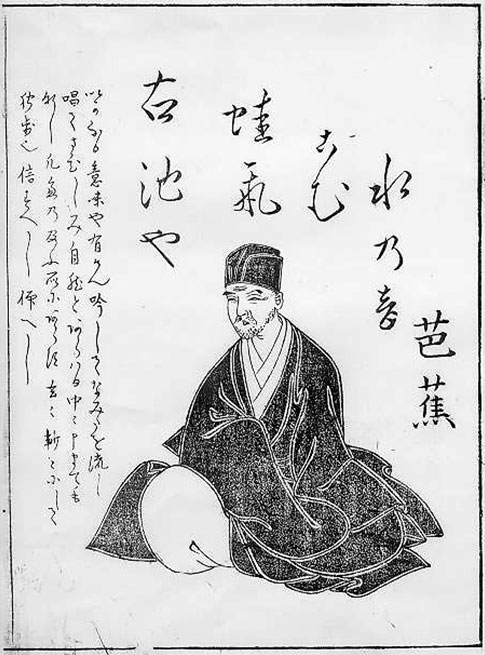
Matsuo Basho
According to Nobuyuki Yuasa, Bashō, in The Narrow Road to the Deep North (Oku no Hosomichi ), “mastered the art of writing haibun so completely that prose and haiku illuminate each other like two mirrors held up facing each other. This is something no one before him was able to achieve.”
Before this, Yuasa writes, Bashō “failed to maintain an adequate balance between prose and haiku, making prose subservient to haiku, or haiku isolated from prose.” The Narrow Road to the Deep Road has become an exemplar for more conservatively-minded, writers of haibun, both Japanese and Westerners. Bashō’s book (amounting to less than fifty pages in translation) is a record of his journey from Edo (as Tokyo was formerly named) to the north and back again, a journey of about 2,400 kilometres and is considered a classic of Japanese literature that is taught in Japanese schools.
The prose element of Bashō’s haibun usually comprises a short paragraph or two, occasionally more, about his visits to monks and abbots, hermitages, shrines and temples, ruined fortifications and scenes of natural beauty in which he records his impressions. It is sometimes replete with references to Shintoism with its homage to spirits of place. It is also full of literary references and he sometimes quotes from famous poems. The accompanying haiku (as well as haiku in general) are imagistic poems that consist of 17 phonetic units (onji in Japanese), similar to but not identical to English syllables, written in a 5/7/5 pattern in a vertical line. Translations of traditional haiku of 17 onji into English generally only require 12 English syllables or even fewer as Japanese onji are often much shorter than English syllables as can be seen in Aitken’s translation at the beginning of this essay. In addition, traditional haiku usually include a kireji or “cutting word” that cuts the haiku into two rhythmical parts, one of twelve onji and the other of five onji, or vice versa (ya is the cutting word in the frog poem here). The cutting word indicates a pause and often signals some emotion arising from the second rhythmical part with which it ends. Thus the practice of writing haiku in English comprised of 5/7/5 syllables in three lines is actually based on a misconception but it is a benign misconception that has resulted in many fine haiku and it is unlikely to disappear. Bashō was to some extent flexible in his use of syllable count. He once instructed a student, “Even if you have three or four extra syllables, or even five or seven you needn’t worry as long as it sounds right. But even if one syllable is stale in your mouth, give it all your attention.” Bashō’s influence goes beyond form though and it is said that he “ … elevated the haikai [haiku] from word-play into lyric poetry, from a game played by poetasters into a spiritual dimension.”
A number of commentators/translators consider Bashō to be primarily a Zen poet, but others are not so sure. Hamill, for example, appears in no doubt and writes of , “a lifetime of consciously perfecting his practice of both Zen and poetry, indeed of making them one seamless practice.” Stryk is less forceful but nevertheless writes, “Bashō’s discussion of poetry was always tinged by Zen thought and what in his maturity he advocated above all was the realization of muga, so close an identification with things one writes of that the self is forgotten … Bashō’s late poems demonstrate that, in spite of periods of acute self-doubt, he was able to achieve a unity of life and art, the great hope of Zen creators.” Yet Barnhill notes that, “cultural memory is a crucial part of Bashō’s apprehension of the present, and allusions to the past are essential to our understanding of some of his hokku [haiku].” Eland writes, “the master of haiku, although he studied with a Zen master in his youth, was always careful to state that he had not attained satori, or enlightenment. His eyes never saw through the earth, and his motto remained, ‘To learn of the pine, go to the pine.’ Thus it was that he spent the last years of his life almost continually on the road. He was paying a visit to the world, a foreigner coming home.” Ueda takes the view that Basho’s main concern in life was not attaining satori but in perfecting the art of haiku.
Bashō’s life and work reveal a complex and sensitive person subject to depression and loneliness who was, arguably, as deeply interested in the writing and teaching of poetry as in following the path of Zen. He did become a lay monk and studied Zen under a well-known teacher for a time. But writing poetry seemed to dominate his life. He wrote, “The invincible power of poetry has reduced me to the condition of a tattered beggar.” Close to his death he told a student, ”I know I shouldn’t be writing haiku now, so close to death. But poetry is all I ever thought of for over fifty years.”
Whatever position you take on Bashō and his relationship to Zen it is important to acknowledge that the writing of haiku for Bashō was not simply a matter of spontaneously capturing in words a moment out of time and thereafter treating them as untouchable. Bashō was a committed reviser of his writings and made repeated, often very subtle, changes. No one knows whether his revisions were designed to better or more accurately express what he experienced or to improve the literary merits of the text. Given that Bashō had a school of poetics with his own students and we have a record of his advice on the use of syllables (onji) I think it would be safe to assume that some of his revisions were designed to improve the literary merits of his texts.
These are some extracts from Iljas Baker’s essay on the life and work of renowned Japanese poet Basho. The full essay with references and explanatory footnotes can be found at Stravaig-17-20-Nov-25.pdf
The essay was published in Stravaig #17, the journal of the Scottish Centre for Geopoetics.